Henry Jones Ripley
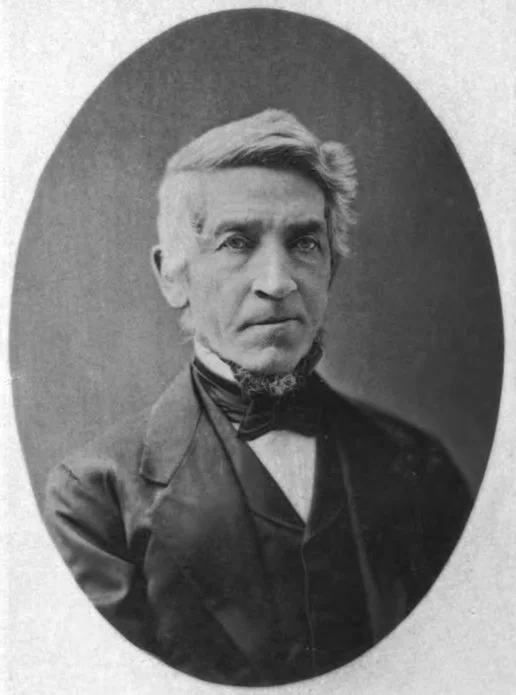
Henry Jones Ripley
The man who would become minister at FBCN and longtime Professor at Newton Theological Seminary, Henry Jones Ripley was born in Boston’s North End and attended Boston Latin on School Street.
What would his school days have been like in 1812? After a rigorous entrance exam, he would have arrived at 7 a.m. in the summer and 8 a.m. in winter for classes. Latin and Greek memorization and recitation dominated the curriculum. There was a mid-day pause for the practice of penmanship and basic arithmetic. Classes would end at 5 p.m. Corporal punishment would have been customary.
Henry received the solid silver Franklin Medal as the top-ranking student in academics as well as for exemplary conduct. At age 14, he entered Harvard and graduated with the class of 1816. He studied for the ministry at Andover Theological Seminary. He was ordained an evangelist in his home church, the Baldwin Place Baptist Church in the North End.
He had read Thomas Clarkson’s two-volume work The History of the Rise, Progress, and Accomplishment of the Abolition of the African Slave-Trade by the British Parliament (1808) and was moved to become part of the Baptist Missionary Service to the Black communities of the South.
Upon graduating from Andover Theological Seminary in 1819 at age 21, Henry accepted a missionary posting to Liberty County, Georgia, where he served as pastor of churches in North Newport and Bryan Neck. From the perspective of over 200 years later, one can only wonder how he reconciled his pro-abolition beliefs with what he witnessed and experienced there.
After a brief period serving as a pastor in Maine, he returned to Liberty County, married Ann Oswald Winn of Liberty County in 1821, and had a son, Henry John Ripley. In 1826, he returned to Newton as the second professor hired by the newly established Newton Theological Seminary—the first Baptist seminary in the United States.
He and his family, which grew to include four daughters, lived at 1301 Centre Street (next to the current FBCN), a location that later became 25–27 Ripley Terrace.
n 1838, FBCN was unable to pay its pastor, Rev. Frederic Willard, and remained without a pastor until 1840. During this time, Professor Ripley was called to "supply the pulpit" alongside his teaching responsibilities, serving until Rev. S.F. Smith was called to the church in 1840.
Rev. Henry Ripley was a member of the faculty of Newton Theological for 34 years. He was also a quietly, influential member of First Baptist for 50 Years. He retired from teaching in 1860.
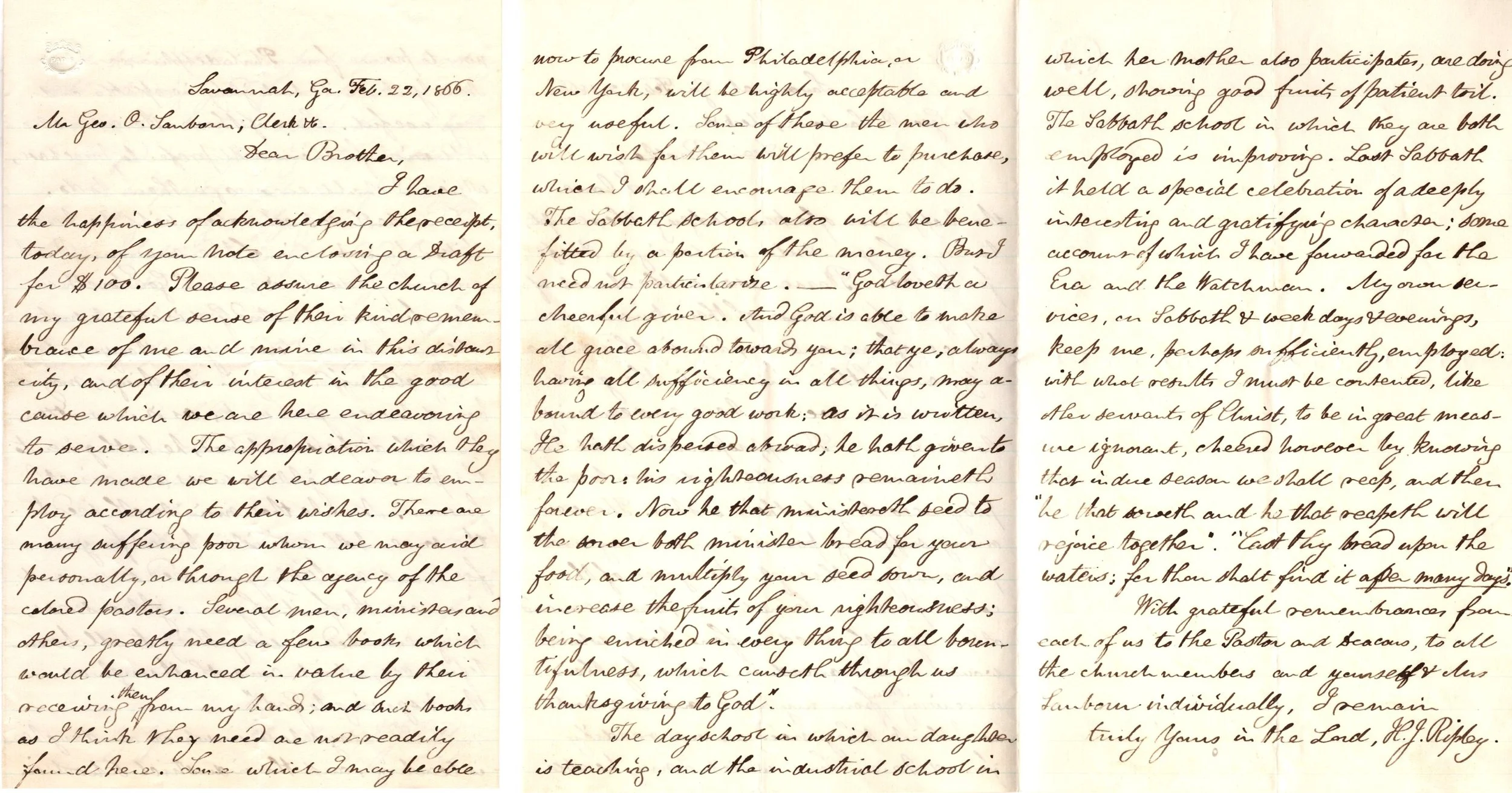
In 1866 at age 68, he accepted a post through the American Baptist Missionary Society to return to the South after the Civil War. Henry and his wife, Ann, and daughter, Frances (a well-loved and respected teacher at the Mason School) spent nine months there teaching and ministering to Black churches and schools. See Ripley’s thank you letter from the FBCN archives to the Missionary Society for their donation.
Ripley can be referred to as “The Grandfather of Historically Black and Colored Universities” as his teachings and example inspired many Newton Theological students to go to the South after the Civil War. Those students were instrumental in founding, leading, and mentoring many universities.
When he returned, Professor Ripley was offered the position of Librarian for the Newton seminary which he took on with energy and commitment. He died at his Newton Centre home with his family by his side. “His end was like the calm closing of a summer’s day.”
Rev Samuel Francis Smith gave the blessing in Ripley’s home. He was buried from First Baptist and rests with his family in Newton Cemetery.