John J. Fogg
It’s reasonable to assume that the John J Fogg Educational Building at FBCN was named for a generous financial donor or a well-known Baptist minister or scholar.
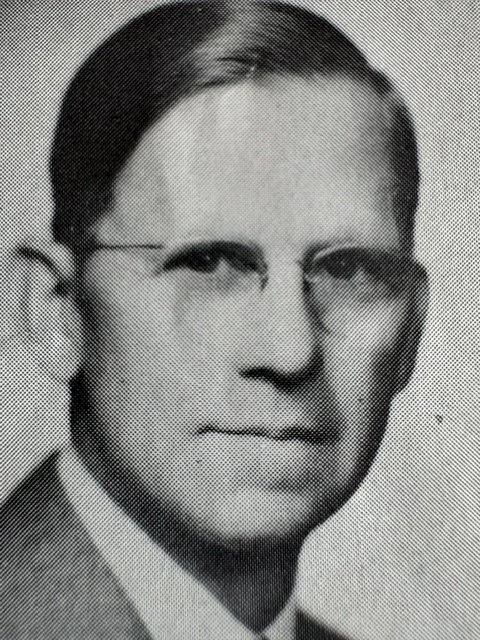
John Jacob Fogg 1887-1979
The reality is much more surprising. The entire church body voted unanimously on July 12, 1964 to name it after member John F Fogg because they liked and admired him. In our contentious age it’s hard to imagine such a vote!
A church report stated, “Mr. Fogg, active in church affairs for many years had long since won the respect and affection of all who knew him”.
Who was John Jacob Fogg? He was born in Roxbury in 1887. His father died when he was four years old. He married when he was 20. He and his wife, Bertha and daughter, Doris, lived at 5 Rotherwood Road in Newton Centre.
He began work in 1919 at the Federal Reserve Bank of Boston, eventually becoming a bank auditor. In 1961 he accepted the position of Chairman of the Building Fund Committee which according to the dedication “assured the ultimate success of the project.”
When construction began in 1963, he agreed to be the Building Coordinator. He died in 1979 at age 92 and was buried from FBCN. He and his family rest in Newton Cemetery.
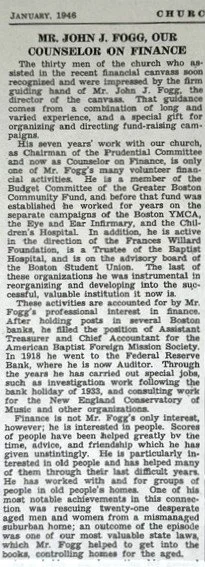
Let's travel back to January 1946 almost 15 years earlier and read what the Church News reported about John Fogg.
His involvement in the issue of state oversight for rest homes is noteworthy.
“He is particularly interested in old people and has helped many of them through their last difficult years. He has worked with and four groups of people in old people’s homes. One of his most notable achievements was in this connection was rescuing twenty-one desperate aged men and women from a mismanaged suburban home; an outcome of the episode was one of our most valuable state laws, which Mr. Fogg helped to get into the books, controlling homes for the aged.
‘The Way Was Found’

The shovel used to break ground on the Fogg Educational Building.
The above sentence was the title of the final report on the Fogg Educational Building. A comprehensive, ambitious, and collaborative plan to raise the funds and build was undertaken by vote of the church in 1960. Harold Knight Associates were named as architects.
It’s hard to imagine that in the decades before 1960 at FBCN, all the numerous activities described in the church bulletins took place in the Chapel, the balcony rooms, the basement and parish house. FBCN membership in 1950 was 1028. The number of Sunday School students was 105. The church was bursting at the seams. A handwritten chronology of the project by Max Brauniger, Clerk, indicates the church members prayerfully considered, evaluated, debated, and decided to go ahead with a firm budget in place. As with all building projects, its costs were revised a number of times until the final price was $235,000.00. The organization of the fundraising was impressive, the desire was there, and the way was found.
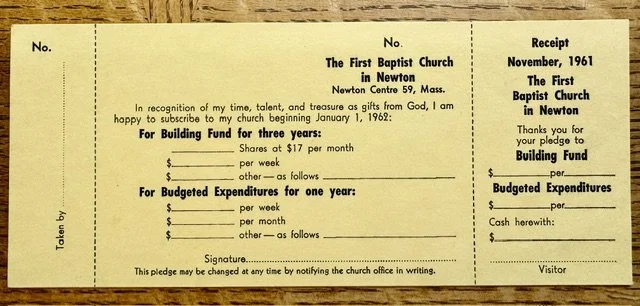
The pledge card used by FBCN to support the building of the Fogg Building.